
AI training for employees: what really works (and what doesn’t)
An employee pastes a contract with a client’s data into ChatGPT to have it summarized. Another sends a text written by the AI to a client without reading it. Neither of them thinks they have done anything serious.
From February 2, 2025, the AI Act requires companies to take care of it. The reference is the’Article 4, which talks about AI literacy. Below you can find what he really says, three real cases that explain why it’s not worth delaying and how to set up training that actually serves a purpose.
What does Article 4 require?
Anyone who develops or uses AI systems in a professional context (this does not mean being a tech company) must adopt measures to grow their staff’s skills. This applies to any organization, regardless of size, and also to those who use AI on behalf of others: external collaborators, agencies, freelancers. The measure must be proportionate to the tasks, context, and people involved.
There is a lot of confusion about this point, so it’s worth saying it clearly. The standard does not require a certificate, does not set a level of competence that is the same for everyone, and does not impose a format: online courses, classrooms, workshops, or internal materials are all fine if they are suitable for those who receive them (European Commission).
Three cases worth knowing about
1. Samsung. In less than a month, three employees inserted source code into ChatGPT, test sequences on chips, and notes from an internal meeting—one of them wanted to turn them into a presentation. No sabotage: they wanted to work faster. That data is now on the OpenAI servers and cannot be recovered (The Register).
2. Air Canada. The company’s chatbot told a passenger that he could request reimbursement for the bereavement fare within 90 days of purchase. That was not true. Air Canada tried to claim that it was not responsible for what the chatbot said. The court decided otherwise: the company is responsible for everything that appears on its website, including the chatbot’s responses, and had to reimburse the difference (CBS News).
3. The lawyers of New York. Two American lawyers cited at least six previous cases created by ChatGPT in court, and the judge fined them $5,000 each. They were professionals, and they treated an AI response as if it were a certain answer (LawNext).
The lesson is not that AI is dangerous. The lesson is that in all three cases, no one told people what was allowed and what wasn’t, and the consequences fell on the company.
Where it happens in a SME
The most common situations are these:
- Studies and services: Customer data pasted into free tools, generated texts sent without control.
- Trade: Chatbots or automated responses that are wrong about prices, returns and warranties. The case of Air Canada, in a nutshell.
- Manufacturing: technical documentation or written quotes with AI without checking the numbers.
- Training and HR: teaching materials generated without review, or CVs evaluated according to a criterion that no one knows about.
A concrete example. A service company with twenty employees discovers that four people routinely use a free AI assistant: one to summarize customer emails, one to write offers, one to translate contracts, one to prepare presentations. None of them received instructions. The instinctive reaction is to ban everything, but that rarely works: people continue to use it, just without saying so. The minimum intervention is to establish which data should never be entered, which texts should be reviewed by a person before sending, and who to contact for questions.
What a training course should contain
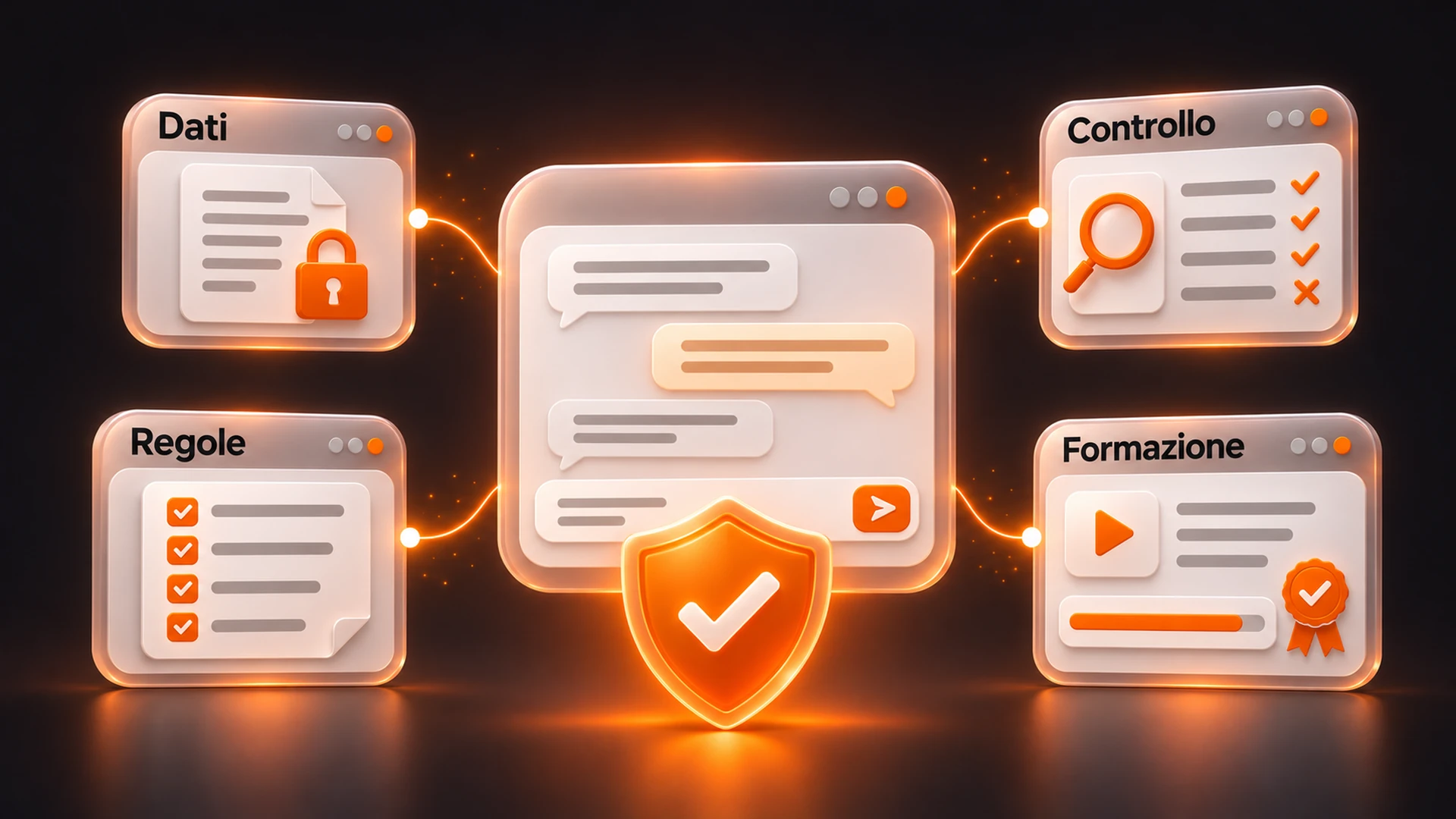
A training made up of generic slides quickly gets forgotten, because no one connects it to their own work. The one that works touches four things.
- The data. Which never get copied (clients, contracts, price lists, trade secrets) and why. It’s worth checking the terms of use of the plan you use as well: what happens to the data you enter changes from one tool to another and between the free and paid versions.
- The control. AI responds with certainty even when it makes mistakes. Those who use it must have a method for reviewing what it produces: numbers, names, references, promised conditions.
- Your cases. Exercises on your emails, your quotes, your documents. That's the part that remains.
- A written rule. A clear page that explains what is allowed, what is not, and who to ask.
Where Nevance comes in
Our service AI Act and NIS2 compliance It has three phases:
- Check of how the company uses AI today.
- Practical training Built on business cases, also through affiliated certification bodies. It concerns the daily use of tools and the limits in using business data. It does not teach how to program AI.
- Compliance documentation, With individual certificates: the law does not require them, but they are used to prove what you have done.
What training does your team really need?
Book a free Discovery Call: we map the AI tools you use and tell you where to start.
 Italiano
 English
 Deutsch